

Paid advertising has changed a lot over the last several years. Running campaigns is no longer just about choosing a few keywords, writing ads, and adjusting bids every once in a while. Today, ad platforms use machine learning to help marketers make smarter decisions faster. That is why AI PPC management has become such an important part of modern digital advertising.
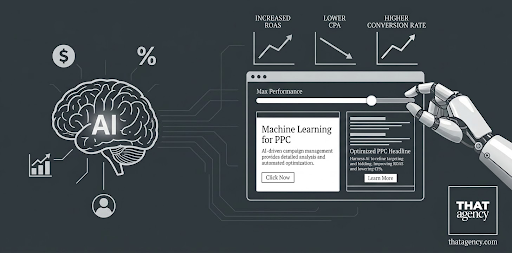
For business owners and marketing leaders, this matters because paid ads need to do more than generate clicks. They need to bring in qualified leads, support revenue goals, and make the most of every dollar spent. AI PPC management helps make that possible by using data to improve how campaigns are built, optimized, and scaled. When done well, it can lead to stronger performance, better lead quality, and more efficient use of your budget.
Machine learning improves paid ad performance by helping campaigns react to real user behavior faster and with more precision. In a manual campaign, a marketer might look at performance trends once a day or once a week and make decisions based on averages. With AI PPC management, the platform can evaluate signals in real time and make adjustments for each auction as it happens.
That matters because not every search is equal. Two people can type in similar keywords and still have very different levels of intent. One person may be casually researching options, while another may be ready to fill out a form, call a business, or make a purchase. Machine learning helps ad platforms look beyond the keyword itself and evaluate context. That can include the user’s device, location, time of day, past behavior, and the likelihood that they will convert.
For example, a campaign may notice that users searching on mobile during business hours in a certain service area are far more likely to call than users searching late at night from outside the target market. Instead of treating those clicks the same, AI can adjust bids based on those patterns. It can push more aggressively when the odds of conversion are stronger and pull back when the traffic looks less valuable.
Machine learning also improves performance by finding patterns people may miss when managing campaigns manually. A human manager may see that one keyword is producing leads. AI can go deeper and identify which combinations of signals within that keyword produce the best results. Over time, it learns from conversion history and uses that information to make more accurate decisions.
This is one of the biggest reasons AI PPC management has become so valuable. It does not just speed things up. It helps campaigns become more responsive, more informed, and more focused on the traffic most likely to drive business results.
In this blog, we will break down what AI PPC management really means, how machine learning supports better ad results, and why this approach is becoming such a valuable part of paid media strategy.
AI PPC management is the use of artificial intelligence and machine learning to improve paid advertising campaigns. It helps platforms like Google Ads and Microsoft Ads make better decisions based on large amounts of data.
Instead of relying only on manual changes, AI can review patterns, user behavior, search intent, device type, location, time of day, and many other signals. It then uses that information to decide how to serve ads more effectively.
This can include:
The main goal of AI PPC management is not to remove strategy from the process. It is to make execution smarter and more efficient.
Paid media is more competitive than ever. Cost per click has gone up in many industries, and businesses need stronger performance from the same or even smaller budgets. At the same time, customer journeys have become more complex. People may search several times, compare options, visit multiple pages, and switch devices before converting.
Trying to manage all of that manually can be difficult. There are simply too many signals and too many moving parts.
That is where AI PPC management becomes valuable. It helps marketers respond faster to real user behavior. Instead of making broad assumptions, campaigns can adjust based on what is actually happening in the moment.
For businesses focused on growth, this creates several advantages:
In other words, AI helps paid advertising become more responsive and more strategic at the same time.
Machine learning is the engine behind AI PPC management. It works by reviewing large amounts of campaign data and finding patterns that help improve performance over time.
Here are some of the main ways it helps.
One of the biggest benefits of AI ad optimization is smarter bidding. In the past, PPC managers often had to update bids manually based on average performance. That took time and usually depended on limited data.
Now, machine learning can help set bids based on the specific context of each auction. It can look at factors like:
This allows the platform to bid more aggressively when a search looks valuable and reduce bids when the opportunity seems weaker.
That kind of real-time adjustment is hard to match with manual bidding alone. It gives businesses a better chance of spending money where it is most likely to produce results.
Targeting has also become more advanced. Instead of relying only on basic audience settings, AI can help platforms understand who is most likely to respond to your ads.
This improves performance in several ways. It can help campaigns:
This is especially useful for businesses trying to balance local targeting with wider market growth. AI can help identify which audiences are worth pursuing and where campaigns are likely to perform best.
Testing is one of the most important parts of any PPC campaign. The challenge is that testing can take time, especially when there are multiple headlines, descriptions, calls to action, and landing pages involved.
AI PPC management helps speed this up. Platforms can automatically test different combinations of creative elements to see what performs best. Over time, the system can favor the strongest combinations and reduce the visibility of weaker ones.
This does not mean creative strategy stops mattering. It actually means strong creative matters even more. If your inputs are clear, relevant, and focused on real customer needs, machine learning has a better foundation to work from.
Budget allocation is another area where machine learning can help. Many businesses run multiple campaigns at once, each with different goals, audiences, and services. Managing budget evenly across all of them may sound fair, but it is not always effective.
AI can help identify where the best opportunities are and direct more spend toward what is producing better returns.
For example, if one campaign is bringing in high-quality leads at a lower cost, AI systems can support stronger performance there while reducing waste in lower-performing areas.
That helps businesses move away from static budget decisions and toward a more flexible, results-driven approach.
This is one of the biggest misunderstandings around automation. Some businesses assume AI PPC management means they can turn on automation and let the platform handle everything.
That is not how strong results happen.
Machine learning can improve execution, but it still needs smart direction. Businesses still need to decide:
Without that strategy, automation can move quickly in the wrong direction. A campaign may generate more conversions, but if those leads are low quality, the performance is not really improving.
The best results happen when human strategy and machine learning work together. The platform handles speed and pattern recognition. The marketing team handles planning, oversight, and business judgment.
One of the most common mistakes businesses make is assuming that automation can replace strategy. It cannot. AI PPC management can improve execution, but it still needs strong direction from experienced marketers who understand the business, the audience, and the goals behind the campaign.
Machine learning can help decide how much to bid, which audience is more likely to convert, and which ad combination may perform best. What it cannot do on its own is decide what kind of lead actually matters to your business. It cannot define your ideal customer, build the right offer, fix weak messaging, or make a landing page more persuasive. Those decisions still require strategy.
This is where human oversight becomes essential. A strong PPC strategy starts with clear goals. Are you trying to drive phone calls, form fills, booked consultations, demo requests, or online sales? Do you want more volume, better quality, or stronger return on ad spend? Those decisions shape how campaigns should be built and what the platform should optimize for.
Without that guidance, automation can move quickly in the wrong direction. A campaign might generate more conversions, but those leads may be unqualified. It may increase traffic, but the traffic may not be coming from people who are likely to buy. That is why leadership teams should look beyond surface-level numbers. More activity does not always mean better performance.
The best results happen when machine learning and human strategy work together. AI handles speed, pattern recognition, and real-time adjustments. A skilled team provides the structure behind the campaign, including audience targeting, ad messaging, landing page direction, budget decisions, and reporting tied to business outcomes. That balance is what turns automation into a real growth tool instead of just another platform feature.
AI PPC management can be powerful, but it works best when the foundation is strong. Before expecting better performance, businesses need to make sure the basics are in place.
If the system does not know what success looks like, it cannot optimize toward it. That means conversion tracking needs to be accurate.
This may include:
Bad tracking leads to bad decisions. Good tracking gives AI useful data to learn from.
Campaigns need clear direction. Are you trying to generate leads, increase online sales, drive store visits, or improve return on ad spend? Each goal changes how the campaign should be managed.
AI performs better when the business objective is clearly defined.
Machine learning improves over time by learning from performance. Campaigns with more data usually give the system more to work with. That does not mean smaller businesses cannot benefit, but it does mean expectations should be realistic.
If a campaign has very little traffic or inconsistent conversions, results may take longer to improve.
Even with good tools, there are still mistakes that can hurt performance. Some of the most common include:
AI can improve a campaign, but it cannot fix poor strategy or weak creative on its own.
Lead quality is one of the biggest concerns for marketing leaders. A campaign may look strong on paper if it generates a lot of conversions, but that does not mean those leads are the right fit for the business.
AI ad optimization can help improve lead quality when it has access to strong conversion signals and clear business priorities. If a business imports offline data, such as which leads became qualified opportunities or actual customers, the system can learn from those outcomes.
That means the campaign is not just chasing volume. It is working toward better-fit prospects.
This is one of the biggest reasons AI PPC management is so valuable. It supports a shift from activity-based reporting to outcome-based marketing. Instead of asking how many clicks or form fills a campaign generated, leaders can start asking a better question: did this campaign help produce real business growth?
Lead quality is one of the most important parts of paid media performance, and it is often where businesses feel the biggest gap between marketing activity and real results. A campaign can generate plenty of clicks and form submissions, but if those leads are not a good fit, the performance is not as strong as it looks. This is where AI ad optimization can make a real difference.
The goal is not just to generate more leads. The goal is to generate better leads. That means attracting people who are more likely to become qualified opportunities, customers, or long-term clients. When campaigns are built the right way, machine learning can help move performance in that direction.
AI works best when it has access to strong conversion signals. If the platform only sees basic actions, like a page visit or a simple form submission, it has a limited view of what success really looks like. But if a business can connect campaign data to deeper outcomes, such as qualified calls, booked consultations, or closed deals, the system becomes much smarter over time.
This is why offline conversion tracking and CRM integration are so important. When ad platforms can learn which leads actually turned into meaningful business results, they can optimize toward the kinds of users most likely to do the same in the future. That changes the conversation from lead volume to lead value.
This is especially important for businesses with longer sales cycles or higher-value services. A company offering professional services, healthcare solutions, home improvement, or B2B support may not need a large number of low-intent leads. It needs the right leads. AI ad optimization helps support that goal by learning from the signals that matter most and shifting campaign delivery toward stronger prospects.
For marketing leaders, this is one of the biggest advantages of AI PPC management. It creates a path toward better reporting, better decision-making, and stronger alignment between ad spend and revenue outcomes. Instead of asking how many leads came in this month, businesses can start asking a more useful question: how many of those leads were actually worth pursuing?
Not every account is at the same stage, but there are several signs that a business may be ready to take advantage of AI PPC management.
You may be a good fit if:
If any of these sound familiar, AI-supported PPC may be worth a closer look.
As ad platforms continue to evolve, AI will become an even bigger part of paid media performance. That does not mean businesses need to chase every new feature. It does mean they should build a smarter foundation now.
That starts with:
These are the pieces that allow AI PPC management to work the way it should.
Businesses that treat machine learning like a shortcut often end up disappointed. Businesses that use it as part of a well-run strategy are much more likely to see better results.
AI PPC management is changing the way paid advertising works, but the biggest benefit is not just automation. It is better decision-making. Machine learning helps marketers respond to data faster, adjust campaigns more effectively, and improve how ad spend supports business goals.
For companies that want cleaner systems, stronger reporting, and more confidence in where their marketing dollars are going, this approach makes a lot of sense. AI ad optimization can improve bidding, targeting, testing, and budget allocation, but it works best when paired with thoughtful strategy and real accountability.
At the end of the day, AI PPC management is not about replacing marketing expertise. It is about making that expertise more effective. When the right strategy, tracking, and oversight are in place, businesses can use AI to create paid campaigns that are smarter, more efficient, and better aligned with growth.
If you are looking for a better way to improve paid ad performance, connect your campaign goals to a stronger PPC strategy and explore how the right team can help you turn ad spend into qualified leads and measurable growth.
AI PPC management is the use of artificial intelligence and machine learning to improve paid advertising campaigns. It helps with bidding, targeting, ad testing, and budget decisions based on performance data.
It helps campaigns respond to real-time signals such as location, device, timing, and user behavior. This can lead to better bid decisions, more efficient spend, and stronger lead generation.
Manual PPC management depends on human review and updates, while AI PPC management uses machine learning to make faster adjustments based on live data. The strongest approach usually combines both.
Yes. AI ad optimization can improve lead quality when campaigns are set up with strong conversion tracking and clear goals. It helps platforms focus more on users who are likely to become qualified leads or customers.
No. AI helps with execution, but it does not replace strategy, messaging, landing page planning, or business judgment. Human oversight is still critical for strong results.
It can be. Small businesses can benefit from AI PPC management if they have reliable tracking, clear campaign goals, and enough data for the platform to learn from over time.
Platforms like Google Ads and Microsoft Ads use machine learning features for bidding, targeting, and ad delivery. These tools help advertisers improve campaign performance more efficiently.
Common mistakes include poor tracking, weak landing pages, focusing only on clicks, and relying too much on automation without enough strategy or review.
AI ad optimization helps by evaluating the value of each search in real time. It can adjust bids based on signals like location, device, timing, and conversion likelihood.
A business should consider AI PPC management when it wants better efficiency, stronger lead quality, less manual workload, and a clearer connection between ad spend and business growth.
Tags: AI, AI Marketing, AI marketing strategies, AI in business, AI Tools
What Is Organic Traffic? (Complete Beginner Guide)
What Is Conversion Rate Optimization? (CRO Basics Explained)
What Is Engagement Rate? (Marketing Metric Explained)

How to Appear in ChatGPT Answers: Understanding AI Citation Signals
AI-Generated SEO Content at Scale: Why Output Without Strategy Damages Authority

700 S. Rosemary Ave.
Suite 204-707
West Palm Beach, FL 33401
P: 561.832.6262
F: 561.832.7707


