Let’s be honest, most marketing metrics look impressive until you ask one simple question: did anyone actually care?
You can drive traffic, rack up impressions, and celebrate reach all day long, but if no one is interacting with your content, you’re not building momentum. You’re just taking up space in a crowded feed.
That’s where the engagement rate formula comes in.
This is the metric that cuts through the noise. It tells you if people are paying attention, responding, and taking action. Not scrolling past. Not ignoring. Actually engaging.
In this guide, we’re breaking down exactly what engagement rate is, how the engagement rate formula works, and how to use it to improve performance across your marketing channels. More importantly, we’re going deeper than most content on this topic by showing how engagement connects directly to growth, visibility, and revenue.
What Is Engagement Rate?
Let’s answer the question clearly: what is engagement rate?
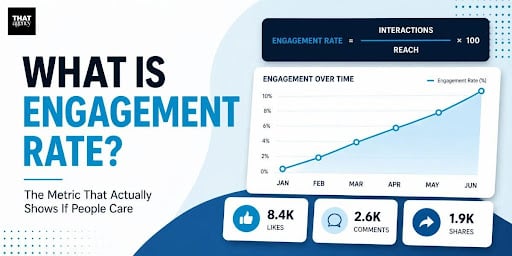
Engagement rate is the percentage of people who interact with your content compared to the number of people who see it.
Those interactions can include things like likes, comments, shares, saves, clicks, replies, and even video views depending on the platform.
But the real meaning goes deeper than that.
When we define what engagement rate is, we are really talking about measuring attention with intent. It is the difference between someone casually seeing your content and someone deciding it is worth interacting with.
A simple way to think about it is this: impressions are foot traffic, engagement is someone stopping, walking in, and starting a conversation.
Why Engagement Rate Matters More Than Most Metrics
A lot of businesses focus on visibility. More impressions, more reach, more followers.
On the surface, that makes sense. But platforms are not designed to reward content that gets seen. They are designed to reward content that keeps people interacting.
If your content is not generating engagement, a few things start to happen:
- Algorithms deprioritize it
- Your reach declines over time
- Your cost per result increases
This is why engagement rate matters.
It shifts the focus from passive exposure to active interaction. Instead of asking how many people saw your content, it asks how many people cared enough to respond.
That is a much stronger signal of performance and long-term growth.
The Engagement Rate Formula Explained
At its core, the engagement rate formula is simple:
Engagement Rate = (Total Engagements / Total Reach) x 100
You take the total number of interactions and divide it by how many people saw the content, then convert it into a percentage.
Simple, but powerful.
What most explanations miss is that this is not the only version of the engagement rate formula. Depending on what you are measuring, the formula can change, and choosing the wrong one can lead to misleading conclusions.
Different Versions of the Engagement Rate Formula
The most commonly used version is based on reach, because it reflects unique viewers and gives the clearest picture of actual engagement.
However, there are other variations that can be useful in specific situations.
You may see engagement calculated using impressions instead of reach, especially in paid campaigns where frequency matters. This includes repeat views, which can lower the engagement rate but provide insight into how often people are exposed to your content.
Another common approach is using follower count. This is often used for benchmarking, especially in influencer marketing, but it has limitations because not all followers actually see your content.
There is also a simplified version that looks at engagement per post, which can help evaluate content efficiency over time.
The key takeaway is this: the engagement rate formula is not one-size-fits-all. You need to choose the version that aligns with your goal.
What Is Engagement Rate Across Marketing Channels?
Understanding what engagement rate is also means understanding how it behaves across different platforms.
On social media, engagement includes likes, comments, shares, and saves. This is where engagement rate has the biggest impact, because platforms actively reward content that keeps users interacting.
In email marketing, engagement looks a little different. Instead of likes and shares, you are measuring opens, clicks, and replies. A common version of the engagement rate formula here focuses on clicks divided by delivered emails.
On websites, engagement becomes behavioral. It includes things like time on page, scroll depth, clicks to other pages, and form submissions. Google has already shifted toward this mindset by emphasizing engaged sessions over bounce rate.
Across all channels, the idea stays the same: engagement rate measures how actively your audience is interacting, not just how many people are exposed.
What Is a Good Engagement Rate?
This is one of the most common questions, and also one of the most misunderstood.
Everyone wants a clean benchmark. Something they can point to and say, “this is good” or “this needs improvement.”
Here’s a general starting point:
- 1 percent to 3 percent is average
- 3 percent to 6 percent is strong
- 6 percent and above is high-performing
But those numbers only tell part of the story.
A 2 percent engagement rate for a large brand with massive reach might actually be a strong performance. On the other hand, a 7 percent engagement rate on a small account might not scale into meaningful growth.
That is why context matters.
A niche B2B company may have lower engagement but a much higher conversion value per interaction. A consumer brand might see higher engagement rates but lower purchase intent.
Platform differences matter too. Engagement on LinkedIn behaves differently than engagement on Instagram. Email engagement operates on an entirely different scale.
The most important benchmark is not industry averages. It is your own performance over time.
If your engagement rate is increasing, your content is improving. If certain content types consistently outperform others, you have a clear direction for your strategy.
That is where real insight comes from.
How to Improve Your Engagement Rate
Knowing the engagement rate formula is one thing. Improving it is where the real work happens.
Most engagement problems are not technical. They are strategic.
Start With Intent
The biggest driver of engagement is alignment.
If your content does not match what your audience is thinking about, searching for, or struggling with, it will not perform. It does not matter how polished it looks.
Strong content starts with understanding:
- What your audience is actively searching for
- What problems they are trying to solve
- What questions they are already asking
When content feels relevant, engagement follows naturally.
Capture Attention Immediately
You have a very small window to earn attention.
If your opening does not pull someone in, they are gone.
Strong hooks work because they are clear and direct. They tell the reader exactly why they should keep reading and what they will get out of it.
Instead of slowly building into your topic, lead with value right away.
Make Engagement Feel Natural
People are more likely to engage when the path is clear.
That does not mean forcing interaction. It means creating moments where engagement makes sense.
Ask a question. Present a choice. Invite a reaction.
Small prompts can significantly increase interaction because they give people a reason to respond instead of just scroll.
Let Data Guide Your Decisions
Your best insights are already in your data.
Look at your top-performing content and identify patterns. Which topics consistently perform well? Which formats drive the most interaction? When is your audience most active?
Once you see those patterns, lean into them.
Engagement improves when you stop guessing and start refining.
Focus on Quality, Not Volume
Posting more content does not guarantee better results.
In fact, low-quality content posted frequently can reduce overall engagement. It trains both your audience and the algorithm to expect less.
High-quality content does the opposite. It creates stronger engagement signals, improves visibility over time, and delivers better results per post.
One strong piece of content will almost always outperform multiple weak ones.
Common Mistakes When Using the Engagement Rate Formula
Even though the engagement rate formula is simple, the way it is used often leads to poor decisions.
One of the biggest mistakes is using the wrong denominator. Choosing between reach, impressions, or followers can significantly change the outcome. If your goal is to measure true audience interaction, reach is usually the most accurate option.
Another common issue is treating all engagement as equal. A like is quick and easy, while a comment or share requires more effort and signals stronger interest. Looking only at total engagement can hide these differences.
There is also a tendency to focus too heavily on percentages without considering scale. A high engagement rate on low reach may look impressive, but it does not always translate into growth. You need both reach and engagement working together.
Finally, many businesses fail to segment their data. Engagement varies across platforms, campaigns, and audience types. Without breaking that data down, it is difficult to see what is actually driving performance.
Engagement Rate vs Other Metrics
To fully understand what engagement rate is, it helps to see how it compares to other metrics.
Impressions measure how many times your content is seen. Engagement rate measures how people respond to it. You can have high impressions with low engagement, which usually signals weak content or poor alignment.
Click-through rate focuses only on clicks, while engagement rate includes all interactions. This makes engagement rate a broader indicator of audience behavior.
Conversion rate takes things a step further by measuring outcomes. Engagement shows interest, while conversions show results. In most cases, strong engagement is a leading indicator of stronger conversion performance.
Applying This: Example Using the Engagement Rate Formula
Let’s look at a simple example.
A post receives:
- 400 likes
- 60 comments
- 40 shares
That gives you 500 total engagements.
If your reach is 10,000:
Engagement Rate = (500 / 10,000) x 100 = 5 percent
That is a strong result.
Now compare that to another post that gets 300 engagements but only reaches 3,000 people.
Engagement Rate = (300 / 3,000) x 100 = 10 percent
Even though the total engagement is lower, the performance is significantly stronger.
This is why the engagement rate formula matters. It measures efficiency, not just volume.
Our Final Thoughts on the Engagement Rate Formula
The engagement rate formula is more than just a calculation. It is a reality check.
It tells you whether your content is connecting or being ignored.
If you have been asking “what is engagement rate,” the answer is simple. It is the clearest signal of whether your marketing is actually working.
When you start using the engagement rate formula correctly, you stop chasing vanity metrics and start focusing on what drives real results.
If you want to turn engagement into measurable growth, contact us for more information or explore our services to see how we can help you build a strategy that delivers real outcomes.
Frequently Asked Questions About Engagement Rate
What is engagement rate in simple terms?
Engagement rate is the percentage of people who interact with your content compared to how many people see it.
What is the most accurate engagement rate formula?
The most accurate engagement rate formula is:
Engagement Rate = (Total Engagements / Reach) x 100
What is a good engagement rate?
A good engagement rate typically falls between 3 percent and 6 percent, but it depends on your industry, platform, and audience.
Why is engagement rate important?
It shows whether your content is resonating with your audience and helps improve visibility, trust, and conversions.
How do you improve engagement rate?
You improve engagement by aligning content with audience intent, using strong hooks, encouraging interaction, and refining your strategy based on performance data.