If you have been asking, what is conversion rate optimization? You are already asking one of the most important questions in digital marketing. A lot of businesses spend time and money trying to get more traffic, but traffic by itself does not grow a business. What matters most is what visitors do after they land on your site.
Do they fill out a contact form? Do they call your business? Do they request a quote, book an appointment, or make a purchase? If they do not take action, then traffic alone is not doing enough for your business.
That is where conversion rate optimization comes in.
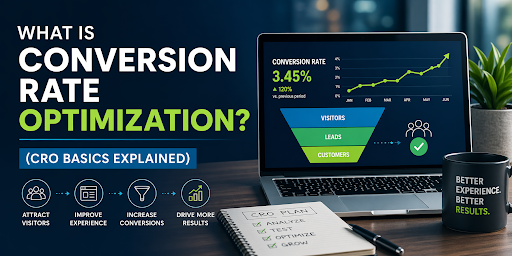
Conversion rate optimization, or CRO, is the process of improving your website so more visitors take action. That action could be filling out a form, making a purchase, signing up for your email list, downloading a resource, or reaching out to your team. In simple terms, CRO helps turn more of your current website visitors into real opportunities.
A conversion is any action that moves someone one step closer to becoming a customer. The exact conversion depends on your business goals. For a service business, it may be a call or form fill. For an ecommerce company, it may be a completed purchase. For a B2B company, it may be a demo request or consultation booking.
Think of it this way. If your website is already getting traffic, CRO helps you get more value from every visitor without spending more money to bring in new ones. Instead of focusing only on getting more people to your site, you focus on improving the experience so the people who are already there are more likely to take the next step.
This matters because even small improvements can make a real difference. If a page gets 1,000 visitors a month and only 20 people convert, that page has a 2 percent conversion rate. If you improve that page and 40 people convert instead, you have doubled your results without increasing traffic at all.
That is why CRO is so valuable. It helps businesses make smarter use of the traffic they already have. It can reveal where users are getting stuck, where messaging is unclear, where trust is missing, or where the next step is too hard to find.
At its core, conversion rate optimization is about removing friction and making it easier for people to take action. That could mean improving headlines, simplifying forms, strengthening calls to action, speeding up the site, or making pages easier to use on mobile devices.
When done well, CRO helps your website work harder for your business. It turns more visits into leads, more clicks into customers, and more marketing effort into measurable results.
What Is Conversion Rate Optimization and Why It Matters
So, what is conversion rate optimization in simple terms?
It is the process of turning more of your existing website traffic into leads, customers, or real business opportunities. Instead of putting all of your focus on getting more clicks, you focus on what happens after the click. That is the difference.
A lot of businesses work hard to bring people to their site. They invest in SEO, paid ads, social media, email campaigns, and other digital marketing efforts. Those channels can bring in traffic, but traffic alone does not pay the bills. What matters is whether those visitors take action once they arrive.
That action could be:
- Filling out a contact form
- Calling your business
- Booking a consultation
- Requesting a quote
- Signing up for a newsletter
- Making a purchase
If people visit your site but leave without doing any of those things, your marketing may be creating attention without creating enough results.
That is why CRO matters.
Conversion rate optimization helps you get more value from the traffic you already have. Instead of spending more money trying to bring in even more visitors, you improve the pages and user experience so more of your current visitors become leads or customers.
Here is why that matters for your business:
- You can get more leads without increasing your ad spend
- You can improve lead quality by making your message clearer
- You can see what is working and what is not
- You can build a stronger marketing system that supports long term growth
This is especially important for businesses that want marketing to be accountable. If you are only looking at traffic numbers, you are only seeing part of the picture. CRO helps you look deeper. It helps you understand which pages are doing their job, which ones are losing opportunities, and where users may be getting stuck.
For example, a page may get a lot of visitors but very few form submissions. That usually means something is not connecting. The offer may not be clear. The call to action may be weak. The form may be too long. The page may load too slowly. Visitors may simply not trust what they are seeing yet.
CRO helps uncover those problems and fix them.
That is what makes conversion rate optimization so valuable. It is not just about getting more traffic. It is about making your existing traffic work harder for your business. When your site is built to convert, your marketing becomes more efficient, your leads become more consistent, and your growth becomes easier to measure.
Many companies spend a lot of time and money bringing people to their website. But if the site is not set up to convert, those visitors leave without taking action.
That is where CRO makes a real impact.
CRO Meaning in Marketing: What It Really Means
CRO Meaning in Marketing Explained
The CRO meaning in marketing is simple, but it has a big impact on how well your digital marketing performs. CRO stands for conversion rate optimization. In plain terms, it means improving your website and marketing funnel so more people take action after they arrive.
That action could be filling out a form, booking a consultation, making a purchase, requesting a quote, or reaching out to your team.
So when we talk about the CRO meaning in marketing, we are really talking about getting better results from the traffic you already have. Instead of only asking how many people visited your website, CRO asks a more important question: how many of those visitors actually did something that moved them closer to becoming a customer?
That is what makes CRO so valuable.
In marketing, CRO connects three important things:
- What your audience is looking for
- What your website shows them
- What action you want them to take
When those three things line up, conversions increase.
For example, if someone searches for a service, lands on your website, quickly understands that you offer what they need, and sees a clear next step, they are much more likely to convert. But if the page is confusing, slow, hard to use, or unclear, that same visitor may leave without taking action.
That is why CRO is not just about design. It is also about messaging, layout, user experience, trust, and clarity.
How CRO Is Different from Other Marketing Efforts
Most marketing efforts are focused on getting attention. That usually means bringing people to your website through SEO, paid ads, email campaigns, social media, or other channels.
CRO focuses on what happens after you have that attention.
Here is a simple breakdown:
|
Focus
|
Traffic Generation
|
Conversion Rate Optimization
|
|
Goal
|
Bring in visitors
|
Turn visitors into leads
|
|
Approach
|
Campaign based
|
Data and testing based
|
|
Success
|
Clicks and views
|
Leads and sales
|
|
Timeline
|
Short term
|
Ongoing improvement
|
This difference matters.
Traffic generation helps fill the top of the funnel. CRO helps move people through it. One brings people in. The other helps convert that interest into real business results.
That is why CRO is so important for business owners and decision makers. It connects marketing activity to outcomes you can measure. Instead of looking only at traffic reports, you start looking at what those visitors are actually doing.
Are they converting?
Are they dropping off?
Are they finding what they expected?
Are your pages helping them take the next step?
Those are the kinds of questions CRO helps answer.
When done well, CRO makes your marketing more efficient. It helps you get more leads from your existing traffic, improve lead quality, and build a stronger system over time. Rather than relying only on new campaigns to create growth, you improve the performance of the website and funnel you already have.
That is the real value behind the CRO meaning in marketing. It turns attention into action and helps connect your marketing efforts to real results.
How Conversion Rate Optimization Works
To really understand what conversion rate optimization is, it helps to look at how it works step by step. CRO is not about guessing, making random updates, or changing your website based on opinion alone. It is a process built on data, user behavior, and steady improvement.
The goal is simple: find out what is stopping people from taking action, make smart changes, and measure whether those changes lead to better results.
Step 1: Look at the Data
Start with real numbers. Before you change anything, you need to understand how people are using your website right now.
This often includes:
- Website traffic and behavior
- Conversion rates
- Bounce rates
- Time on page
- Click patterns
- Where users drop off in the process
This step gives you a clear starting point. It helps you move away from assumptions and focus on what is actually happening.
For example, a page may be getting plenty of traffic, but very few people are filling out the form. That tells you the problem may not be traffic. The problem may be the page itself.
A common question readers may have here is, “Why do I need data first?”
The answer is simple. If you do not know where the problem is, you cannot fix it the right way. Data helps you find the gap between traffic and results.
Step 2: Find What Is Not Working
Once you have the data, the next step is to look for friction points. These are areas where users slow down, get confused, hesitate, or leave the page without taking action.
Common issues include:
- Pages that are hard to navigate
- Slow loading times
- Forms that ask for too much information
- Weak or unclear calls to action
- Mobile layouts that are difficult to use
- Headlines that do not explain the value clearly
- Pages that feel cluttered or overwhelming
This step matters because small problems can create big losses. If a visitor cannot quickly understand what the page is offering or what to do next, they may leave without converting.
You might be wondering, “What is a friction point in simple terms?”
It is anything that makes it harder for a user to take the next step.
That could be a confusing button, a long form, too much text, poor design, or even a page that loads too slowly. Friction creates hesitation, and hesitation often leads to lost conversions.
Step 3: Make a Plan
After you identify what is not working, create a simple plan based on what you found. This is where strategy comes in.
For example, your plan might be to:
- Shorten the form to increase submissions
- Improve the headline to make the value clearer
- Move the call to action higher on the page
- Add trust signals like reviews or testimonials
- Make the page easier to use on mobile
The key here is to make focused changes, not random ones.
A lot of businesses make the mistake of changing too many things at once. That makes it harder to know what actually improved the results. A better approach is to choose the most likely issue, make one smart update, and measure the outcome.
If you are asking, “How do I know what to fix first?” start with the biggest barriers to action. Look for pages with strong traffic but weak conversions. Those pages often have the clearest opportunities.
Step 4: Test Changes
Once you have a plan, test the changes. This is where CRO becomes practical.
Testing means making one change at a time and watching how users respond. That way, you can see what actually works instead of relying on opinions.
For example, you may test:
- A shorter form against a longer form
- A new headline against the current one
- A different button placement or call to action
- A cleaner page layout with less clutter
This step helps you answer an important question: did the change improve performance?
That is what makes CRO different from guessing. You are not changing things because they look better. You are changing them because you want better results, and you are measuring whether that happens.
A common question here is, “Do I always need A/B testing?”
Not always. A/B testing is helpful, but not every business needs a formal test for every update. Sometimes a clear improvement, such as fixing a broken form or speeding up a slow page, can be tracked through normal performance reporting. The important part is measuring the impact.
Step 5: Keep Improving
CRO is not a one time fix. It is an ongoing process. You test, learn, and improve over time.
That is what makes it so valuable.
User behavior changes. Markets shift. Traffic sources change. What worked six months ago may not work as well today. That is why CRO works best when it becomes part of your regular marketing process.
Over time, this approach helps you:
- Get more value from your existing traffic
- Improve lead quality
- Reduce wasted marketing spend
- Build a stronger and more reliable conversion system
This is one of the biggest reasons conversion rate optimization matters so much. It is not just about one page or one form. It is about creating a better path for users and a stronger return from your marketing efforts.
In simple terms, CRO works by helping you understand what users are doing, where they are getting stuck, and what changes help them move forward. When you follow that process step by step, your website becomes more effective, your marketing becomes more efficient, and your results become easier to improve over time.
Key Factors That Impact Conversions
If you want to fully understand what conversion rate optimization is, you need to know what actually influences whether someone takes action on your site. Conversions do not happen by accident. They happen when the experience, message, and next step all make sense to the user.
When one of those pieces is missing, people hesitate or leave.
Below are the key factors that have the biggest impact on conversion rates and how to think about improving each one.
Website Experience
Your website experience sets the tone right away. When someone lands on your site, they should be able to move through it without confusion.
A strong website experience means visitors can quickly find what they need and understand what to do next.
Focus on:
- Clear layout that guides users from one section to the next
- Fast load speed so visitors are not waiting
- Mobile friendly design that works smoothly on phones and tablets
- Simple navigation that makes it easy to explore your site
If your site feels hard to use, people will leave. Even small issues like slow load times or cluttered pages can lower your conversion rate.
A common question is, “How fast should my website be?”
Most users expect pages to load in a few seconds or less. If it takes too long, many will leave before they even see your content.
Clear Messaging
Once someone is on your site, your message needs to be clear right away.
Visitors should not have to guess what you do or who you help. If they do, they will move on to another option.
People should quickly understand:
- What you offer
- Who it is for
- Why it matters
Your messaging should answer these questions within the first few seconds.
For example, if a visitor lands on a service page, they should immediately see that you provide that service, who it is designed for, and what result they can expect.
If your message is vague or filled with generic language, users may not feel confident enough to take action.
A good way to check your messaging is to ask, “Would a first time visitor understand this page in under 10 seconds?” If the answer is no, there is room to improve.
Strong Calls to Action
A call to action, or CTA, tells users what to do next. Without a clear CTA, even interested visitors may not take the next step.
Good calls to action are:
- Easy to see on the page
- Clear and direct about what will happen next
- Focused on one main action
For example, instead of using a vague button like “Submit,” a stronger CTA might say:
- Request a Quote
- Book a Consultation
- Get Started Today
These types of CTAs remove guesswork and guide the user forward.
A common question here is, “How many CTAs should a page have?”
In most cases, it is best to focus on one primary action. You can repeat that CTA throughout the page, but you do not want to overwhelm the user with too many choices.
Trust Signals
Before someone takes action, they need to feel confident in your business. Trust plays a big role in whether a visitor converts.
If your site does not build trust, users may hesitate, even if they are interested in what you offer.
Trust signals can include:
- Reviews and testimonials from real customers
- Case studies that show results
- Clear contact details such as phone number and address
- Years in business or experience highlights
- Certifications, awards, or partnerships
These elements help answer an important question in the user’s mind: “Can I trust this business?”
Even adding a few strong trust signals can improve conversion rates.
Matching User Intent
One of the most important factors in conversion rate optimization is matching user intent.
User intent is the reason someone clicked on your page in the first place.
For example:
- If someone searches for a specific service, they expect to land on a page about that service
- If someone clicks on an ad offering a free consultation, they expect to see that offer clearly on the page
If your page does not match what the user expected, they will leave.
This is a common issue in marketing. A user clicks on a link, but the page does not clearly deliver what was promised. That disconnect creates frustration and lowers conversions.
To fix this, make sure your content aligns with:
- The search or ad that brought the user to the page
- The problem they are trying to solve
- The next step they are ready to take
A helpful question to ask is, “Does this page clearly match why someone clicked in the first place?”
If the answer is yes, you are much more likely to see stronger conversion rates.
When you bring all of these factors together, you start to see how conversion rate optimization works in practice. It is not just one change or one update. It is about improving the full experience so visitors can move forward with confidence and take action without hesitation.
CRO Meaning in Marketing: How It Shows Up in Real Life
Where CRO Makes the Biggest Impact
The CRO meaning in marketing becomes much clearer when you look at how it shows up in day to day business operations. CRO is not something abstract. It directly affects how your website performs and how many leads or sales you generate from your existing traffic.
Most businesses already have key areas on their website where conversions are supposed to happen. These are the places where users decide whether to take action or leave.
Common areas where CRO has the biggest impact include:
- Landing pages for ads
- Service pages on your website
- Contact forms and lead funnels
- Online checkout processes
Each of these areas plays a direct role in turning visitors into customers.
For example, a landing page tied to a paid ad campaign should clearly match the message of the ad and guide the user toward one action. If that page is unclear or difficult to use, you may still get clicks, but you will lose conversions.
Service pages are another major opportunity. These pages often bring in high intent traffic from search engines. If they are well structured, easy to read, and clearly explain your value, they can generate consistent leads. If not, users may leave and look elsewhere.
Contact forms and lead funnels are also critical. Even small issues, such as asking for too much information or not clearly explaining what happens next, can reduce the number of people who complete the form.
For ecommerce businesses, the checkout process is one of the most important areas to review. Complicated steps, unexpected costs, or slow load times can cause users to abandon their purchase.
A common question here is, “Where should I start with CRO?”
A good starting point is to look at pages that already get traffic but are not converting well. Those pages usually have the biggest opportunity for improvement.
Small improvements in these areas can lead to big gains over time. You do not always need a full redesign. In many cases, a few focused updates can make a noticeable difference.
Real Example
A service based business was getting steady traffic through SEO and paid ads, but they were not seeing enough leads. At first, it seemed like a traffic issue, but a closer look at the website told a different story.
After reviewing their site, a few issues stood out:
- The contact form was too long and asked for more information than necessary
- The main call to action was hard to find and not clearly visible
- The messaging did not clearly explain the value of the service
These issues created friction. Visitors were interested enough to click through to the site, but not confident or motivated enough to take the next step.
Instead of increasing the ad budget or trying to bring in more traffic, the focus shifted to improving how the site converted.
After making a series of simple, targeted changes:
- The form was shortened to reduce effort for the user
- The call to action was moved higher on the page and made more visible
- The messaging was rewritten to clearly explain the benefits and who the service was for
The results were clear:
- Leads increased by over 30 percent
- Visitors spent more time on the site
- The leads that came in were more qualified and aligned with the business
Nothing about the traffic changed. The number of visitors stayed the same. The difference came from improving how the site converted.
This is a strong example of the CRO meaning in marketing in action. It shows how focusing on user experience and clarity can unlock better results without increasing marketing spend.
For many businesses, this is where the biggest opportunity exists. Not in getting more traffic, but in making better use of the traffic they already have.
Common CRO Mistakes to Avoid
Even when you understand what is conversion rate optimization, it is still easy to make mistakes. Many businesses start making updates with good intentions, but without a clear process, those changes do not always lead to better results.
Here are some of the most common CRO mistakes to watch for and how to think about fixing them.
Making Changes Without Looking at Data
One of the biggest mistakes is making decisions based on opinions instead of data.
It is easy to think a page needs a redesign or a new headline, but without looking at how users are actually interacting with the page, you may fix the wrong problem.
Before making changes, look at:
- Where users are dropping off
- Which pages have high traffic but low conversions
- How users move through your site
A common question here is, “Do I always need advanced tools?”
Not necessarily. Even basic analytics can give you enough insight to start identifying problems. The key is to base decisions on real behavior, not guesses.
Changing Too Many Things at Once
Another mistake is updating too many elements at the same time.
If you change the headline, layout, form, and call to action all at once, it becomes very hard to know which change actually improved performance.
A better approach is to:
- Focus on one key issue at a time
- Make one clear change
- Measure the result
This makes your CRO efforts more controlled and easier to learn from.
Ignoring Mobile Users
A large portion of website traffic comes from mobile devices. If your site does not work well on a phone, you are likely losing conversions.
Common mobile issues include:
- Buttons that are hard to tap
- Text that is difficult to read
- Forms that are too long or hard to complete
- Pages that load slowly
A helpful question to ask is, “Would I complete this form or take action on my phone?” If the answer is no, your users likely feel the same way.
Focusing Only on Design Instead of Messaging
Design matters, but messaging often has a bigger impact on conversions.
You can have a clean, modern website, but if users do not clearly understand what you offer or why it matters, they will not take action.
Make sure your pages clearly answer:
- What do you offer?
- Who is it for?
- Why should someone choose you?
If those answers are not obvious, improving the design alone will not fix the problem.
Treating CRO Like a One Time Project
CRO is not something you do once and then forget about.
User behavior changes. Competition changes. Your business goals may change as well.
If you treat CRO like a one time update, your results may improve for a short time but then level off.
CRO works best when it becomes part of your ongoing marketing strategy. Regular testing, updates, and reviews help you keep improving over time.
How CRO Supports Long Term Growth
For business owners and leadership teams, understanding what is conversion rate optimization is not just about improving one page or one campaign. It is about building a stronger, more reliable marketing system.
CRO supports long term growth by helping your website perform better month after month.
Here is how it helps:
- Get more value from your current traffic
- Improve return on investment across your marketing channels
- Better understand how your customers think and behave
- Create a more predictable flow of leads and inquiries
Instead of constantly trying to get more traffic, you improve how your current traffic performs. That shift can make your marketing more efficient and easier to scale.
A common question business owners ask is, “Should we focus on traffic or conversions first?”
The answer is both, but CRO often unlocks faster gains. If you already have traffic, improving conversions can quickly increase results without increasing spend.
Over time, CRO also helps you make smarter decisions. You learn what messaging works, which pages perform best, and where users tend to drop off. That insight can be used across all of your marketing efforts, from SEO to paid ads to landing pages.
This approach fits well for leaders who want clear results, better reporting, and a system they can trust to support growth. It moves marketing away from guesswork and toward a more structured, measurable process.
When CRO becomes part of your strategy, your website becomes more than just a digital presence. It becomes a tool that consistently supports lead generation and business growth.
Frequently Asked Questions About What Is Conversion Rate Optimization
What is conversion rate optimization in simple terms?
What is conversion rate optimization in simple terms? It means improving your website so more visitors take action. Instead of focusing only on getting traffic, CRO focuses on what those visitors do once they arrive. The goal is to turn more of that traffic into leads, customers, or inquiries.
Why is conversion rate optimization important?
Conversion rate optimization is important because it helps you get better results without increasing your marketing spend. If your website converts more visitors, you generate more leads and sales from the same amount of traffic. This makes your marketing more efficient and easier to scale over time.
What is the CRO meaning in marketing?
The CRO meaning in marketing is about improving how users move through your website and marketing funnel so they are more likely to convert. It connects your traffic efforts with real outcomes, such as form submissions, calls, or purchases, instead of just clicks and views.
How long does CRO take to work?
Some CRO changes can improve results quickly, especially if you fix clear issues like slow pages or long forms. Other changes take more time because they need testing and data to confirm what works best. The most important thing is to keep testing and improving instead of expecting instant results.
What tools help with CRO?
Several tools can help you understand user behavior and improve your conversion rates. These include:
- Google Analytics for tracking traffic and conversions
- Heatmaps to see where users click and scroll
- Session recordings to watch how users interact with your site
- A/B testing tools to compare different versions of a page
You do not need every tool to get started. Even basic data can help you identify opportunities.
Can small businesses use conversion rate optimization?
Yes. CRO works for businesses of any size. In fact, small businesses can often see quick improvements because even small changes can have a noticeable impact. Simple updates like clearer messaging, better calls to action, and shorter forms can lead to more leads without increasing your budget.
Ready to Improve Your Conversion Rate Optimization Strategy?
Now that you understand what conversion rate optimization is, the next step is putting it into action.
CRO is not about guessing or making random updates. It is about making smart, data driven improvements that help more visitors take action. Over time, those improvements add up and create stronger, more consistent results.
At THAT Agency, we help businesses connect traffic to real outcomes. Our approach focuses on clear strategy, consistent improvement, and measurable growth so you can see how your marketing is contributing to revenue.
If you want to improve your conversion rates and get more qualified leads from your website, contact us to get started.