

Choosing the right marketing partner can feel overwhelming. There are large agencies, small teams, freelancers, and everything in between. Many business owners and marketing leaders find themselves asking the same question: is a boutique creative agency the right fit for our goals?

In the first stages of that decision, it helps to understand what a boutique creative agency really is, how it works, and when it makes the most sense to hire one. This guide explains the boutique agency meaning in clear, practical terms. It is written for leaders who want straightforward answers, clear expectations, and marketing systems that support steady growth.
A boutique creative agency is a smaller marketing agency that works with a limited number of clients at one time. Instead of trying to serve every industry or offer every possible service, a boutique creative agency focuses on a defined set of skills and clients it can support well.
The main idea behind a boutique creative agency is focus. These agencies build close working relationships and take time to understand your business, your audience, and your goals. The same people who help plan your strategy are often the ones helping execute and review the work.
Common traits of a boutique creative agency include:
This structure often feels more personal and easier to manage than working with a large agency. Many boutique agencies specialize deeply in areas like B2B digital marketing strategies, local and regional SEO, or high intent lead generation rather than broad awareness campaigns.
The phrase boutique agency meaning is not about being trendy or exclusive. It describes how an agency chooses to work.
In simple terms, boutique agency meaning comes down to three ideas:
A boutique agency chooses quality over volume. It limits the number of clients so each account gets real attention. This approach pairs naturally with structured frameworks like marketing strategy examples that evolve as results come in, rather than staying static for months.
Some people assume a boutique creative agency is just a freelancer with a nicer website. There is an important difference.
A boutique creative agency usually includes:
Freelancers often work alone and may not offer the same level of support, continuity, or scalability. Boutique agencies are better positioned to connect work back to outcomes like inbound leads vs outbound leads, customer acquisition, and long term growth.
If we are choosing between a boutique creative agency and a large agency, the “best” option is not about who has the biggest team. It is about which model fits the way we work, how fast we need to move, and how closely we want marketing tied to revenue and lead quality.
A boutique creative agency often feels more like an in house partner. A large agency often feels more like a structured vendor. Both can do good work, but they usually operate in very different ways. This difference becomes especially clear when comparing strategic depth versus scale driven execution, a distinction often discussed when evaluating marketing vs advertising agencies.
Below is a deeper breakdown of the differences that tend to matter most to marketing minded leaders.
Large agencies are built to handle volume. To manage many accounts at once, they usually add layers. That can protect their time, but it can also slow things down for the client.
A common large agency setup looks like this:
This can work fine when the project is simple or highly standardized. It can get frustrating when we need quick changes, clear answers, or strategy support that goes beyond basic task management.
With a boutique creative agency, communication usually feels more direct:
Direct communication supports faster response times and clearer accountability, especially when paired with ongoing competition monitoring and competitive content analysis.
When something changes quickly, like a competitor launches a new offer, a campaign starts pulling lower quality leads, or we need to adjust messaging to fit a seasonal push, the communication model matters.
A boutique creative agency can often move faster because:
Marketing decisions often sit on small details. A slow communication loop can mean wasted ad spend, missed lead opportunities, or delays in launching improvements.
Direct access usually leads to:
Large agencies tend to rely on established systems that work across many accounts. This helps them deliver at scale, but it can also create a “template” feel. That template might not match our market, our goals, or our internal sales process.
Large agency strategy can sometimes feel like this:
A boutique creative agency is usually more flexible because it is built to focus, not to scale volume. They can adjust SEO, paid media, or content strategies in real time based on performance insights from tools, platforms, and reporting systems like those outlined in top SEO tools of the year and modern analytics stacks.
That flexibility often shows up as:
Flexibility matters most when we are in a competitive environment, especially local and regional markets where:
A boutique creative agency is often better positioned to respond to those shifts because the work is not stuck in a rigid process.
Flexibility is great, but it still needs structure. The best boutique agencies combine speed with a clear plan.
A strong setup looks like:
Strategies like ranking for multiple locations with SEO or responding to local competition require ongoing refinement.
Reporting is where many agency relationships either build trust or lose it.
Large agencies often send reports that look polished but do not answer the real questions. The report may show impressions, clicks, and traffic, but not what leadership cares about.
Common frustrations with large agency reporting include:
A boutique creative agency usually has a stronger incentive to keep reporting simple and meaningful. Because they work closely with fewer clients, they tend to spend more time connecting performance to business goals.
Boutique reporting often focuses on:
No matter what type of agency we choose, reporting should answer these questions:
If a report does not answer those, it is usually not doing its job. Many boutique agencies integrate insights from marketing analytics and forward looking models like predictive analytics in marketing to guide decision making.
Here is a simple side by side view.
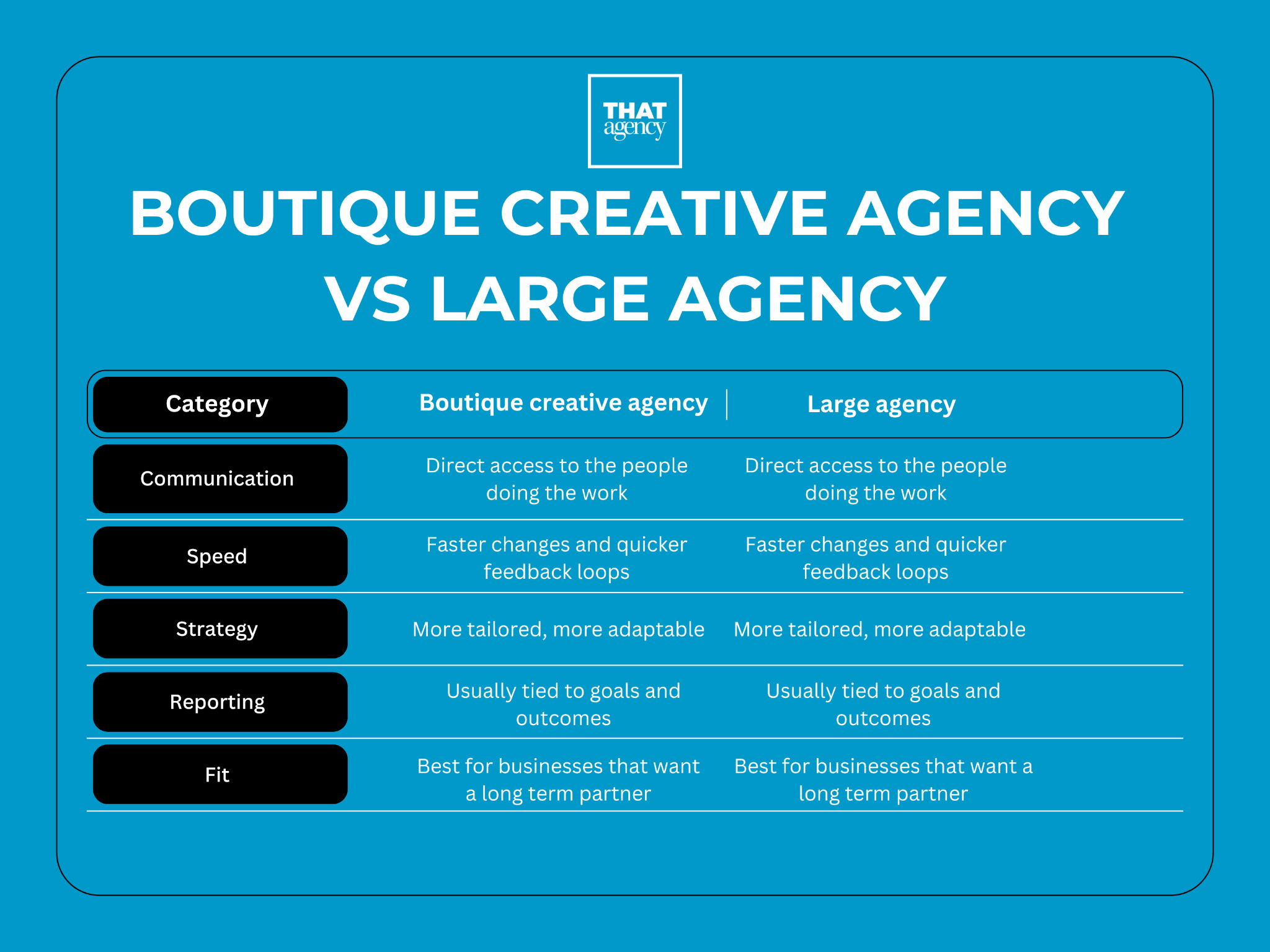
Not at all. A boutique creative agency can be a strong fit for small, mid sized, and even larger businesses. The best fit depends on what we value most. If we want faster communication, clear reporting, and a partner that feels close to the business, boutique can work at many sizes.
We might get fewer “people,” but that does not always mean fewer results. Many boutique agencies are built around senior level talent, tighter execution, and better focus. The real question is whether the resources match the work we need done.
Yes, especially if we are a priority account and have strong communication channels. The challenge is that flexibility often depends on internal approval paths. It is worth asking how changes get made and how long updates usually take.
Here are a few questions that quickly show how an agency operates:
ROI depends on execution, not just agency size. That said, many marketing leaders see strong ROI from boutique agencies because of faster feedback loops, more tailored strategy, and clearer accountability. Large agencies can also drive ROI, especially for brands that need scale and have a clear internal process.
A boutique creative agency tends to be the better fit when we want clear communication, faster decisions, and strategy that stays tied to business outcomes. A large agency can be a good fit when we need scale, many service departments, and strict processes.
If we are deciding between the two, the best move is to match the agency model to how we operate internally, how fast we need to move, and how closely we want marketing connected to measurable growth.
Not every boutique creative agency offers the same services, but most focus on areas that support long term growth and measurable outcomes.
Common services include:
Rather than offering every service available, boutique agencies focus on what they can deliver well and track clearly.
A boutique creative agency is not the right solution for every business. It works best in certain situations.
If your marketing feels scattered or hard to measure, a boutique creative agency can help bring things together.
This is common when:
Businesses that view marketing as an ongoing system often benefit most from boutique agencies.
This includes teams that:
Local and regional growth requires attention to detail. A boutique creative agency often has the flexibility to adjust strategy based on location data and performance.
This is helpful for:
Being honest about fit helps avoid frustration later.
A boutique creative agency may not be ideal if:
In those cases, a larger agency or different model may make more sense.
Pricing varies, but boutique agencies often focus on value instead of volume.
Your investment usually supports:
While a boutique creative agency may not be the cheapest option, many businesses find the return comes from better focus and less wasted effort.
Before hiring, it helps to ask the right questions.
Key questions include:
Clear answers signal a healthy partnership.
A regional service business wants better leads, not just more traffic. A boutique creative agency reviews current campaigns, refines messaging, and builds a system that improves lead quality over time.
A marketing director feels stretched trying to align different vendors. A boutique creative agency steps in to centralize strategy and reporting, making everything easier to manage.
A founder who handled marketing early on now needs structure. A boutique creative agency helps build processes that support growth without unnecessary complexity.
A boutique creative agency helps plan, execute, and track marketing efforts with a strong focus on strategy and outcomes. The work is tailored to your business goals instead of using generic templates.
Boutique agency meaning focuses on depth and attention. Full service agencies often manage many clients and offer many services, while boutique agencies limit scope to maintain quality and consistency.
A boutique creative agency can be a strong fit for small and mid sized businesses that want senior level attention and clear strategy. Fit depends on goals, not company size alone.
Results depend on the channel. Paid ads may show changes within weeks. SEO and content usually take a few months. A boutique creative agency should set clear expectations upfront.
You should expect reporting that focuses on leads, conversions, and engagement quality. A boutique creative agency should explain what the numbers mean and what happens next.
Yes. Many boutique agencies work as an extension of internal teams, offering strategy and execution support without the cost of hiring full time staff.
A boutique creative agency offers a focused and relationship driven approach to marketing. For leaders who value clarity, consistency, and steady growth, this model can provide the structure and support needed to move forward with confidence.
Understanding boutique agency meaning helps you choose a partner that aligns with your goals and expectations. If you are looking for a marketing partner that feels collaborative, transparent, and results focused, a boutique creative agency may be the right next step. Contact us to learn more about how THAT Agency helps businesses build clear, reliable marketing systems that support long term growth.

Tags: Digital Marketing, website optimization, 2024 Marketing Strategies, Luxury Marketing, Boutique Agency
What Is Organic Traffic? (Complete Beginner Guide)
What Is Conversion Rate Optimization? (CRO Basics Explained)
What Is Engagement Rate? (Marketing Metric Explained)

How to Appear in ChatGPT Answers: Understanding AI Citation Signals

AI-Generated SEO Content at Scale: Why Output Without Strategy Damages Authority

700 S. Rosemary Ave.
Suite 204-707
West Palm Beach, FL 33401
P: 561.832.6262
F: 561.832.7707


