

Voice search isn’t “the future” anymore, it’s already reshaping how consumers discover brands, make decisions, and take action. From asking Alexa about the weather to using Siri to find a nearby service provider, voice-based search continues to grow fast, and it’s changing how businesses need to think about visibility. But what is voice search optimization?
With 71% of consumers preferring voice search when possible and billions of devices now powered by voice assistants, the question isn’t if your customers are searching by voice, it’s whether your brand is the one being recommended when they do.
That’s where voice search optimization comes in.
This guide breaks down what voice search optimization actually is, how it differs from traditional SEO, why it matters for revenue-driven businesses, and the strategic steps you can take to win in voice-based results.
What is voice search optimization? Voice search optimization is the process of structuring your website and content so voice assistants, like Siri, Alexa, and Google Assistant, can easily understand, extract, and deliver your answers when users speak their queries out loud.
While traditional SEO focuses on short, typed keywords like:
Voice search optimization focuses on full, conversational questions, such as:
In other words:
Typed search = shorthand
Voice search = natural language
Optimizing for voice requires:
And because smart speakers, in-car systems, and mobile assistants all rely on a single response, voice optimization becomes high-stakes SEO: you’re either the answer, or you’re invisible.
Voice search isn’t just convenient for consumers, it’s a massive opportunity for businesses that understand intent.
And the data is clear:
People aren’t casually experimenting with voice search, they’re using it habitually for:
Voice search users are often high-intent searchers, meaning they’re closer to taking action than someone scrolling casually through a typed search.
**If your content isn’t optimized for voice… you’re not just losing traffic, you’re losing ready-to-convert buyers.**
In traditional search, you might get 10 links to choose from.
But voice search?
You get one answer.
When a user asks:
The assistant selects one business, the one it believes provides the clearest, most authoritative answer.
That answer almost always comes from:
This is why voice search is high-impact SEO:
Winning means dominating the result. Losing means disappearing.
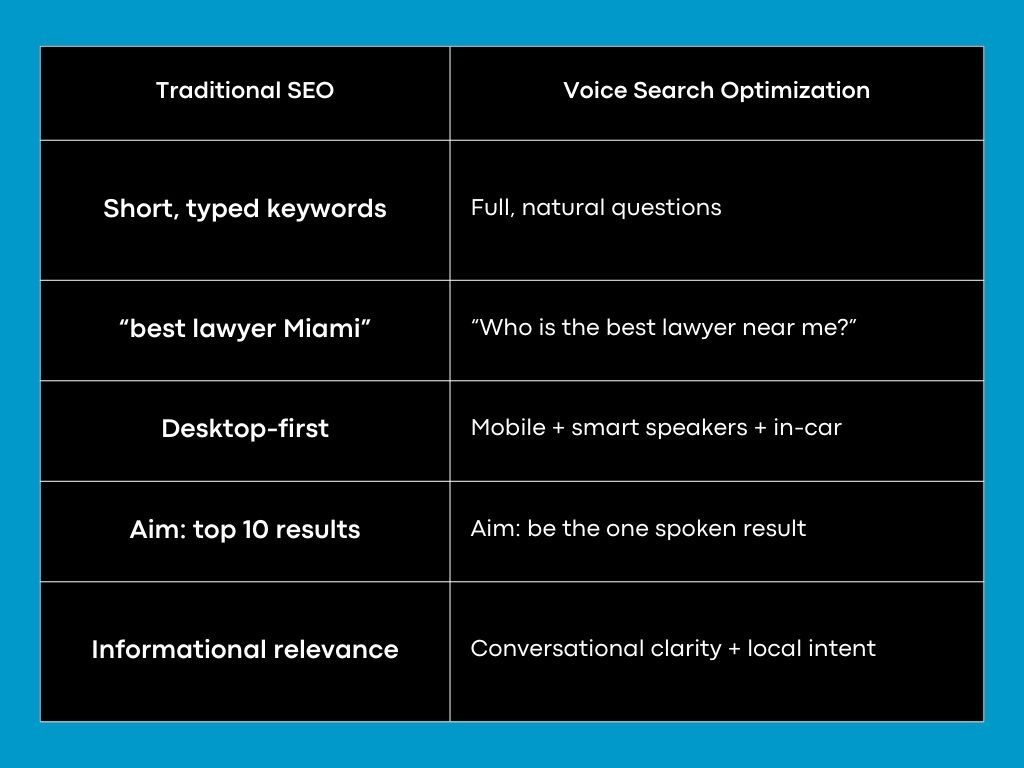
Traditional SEO will always matter, but voice search requires an additional layer of strategy built around intent, natural language, and direct answers. This requires content aligned with semantic search and intent.

People speak differently than they type.
Typed:
“SEO agency near me”
Spoken:
“What’s the best SEO agency near me for small businesses?”
That’s why voice-friendly content needs:
Tools like AnswerThePublic and People Also Ask help identify voice-style queries based on consumer behavior.
Featured snippets, the boxes at the top of Google, are often the source of voice assistant responses.
To optimize for snippets:
You don’t need to rank #1, you just need the best, clearest answer. This strengthens visibility across traditional search and AI-driven results.
Voice search skews local, heavily.
Most spoken searches are variations of:
Optimizing for local voice search means:
Reviews matter more than ever, Google uses review language to understand your relevance. This aligns with proven local SEO strategies that outperform in competitive markets.
Voice search is inherently mobile, and mobile users expect instant load times.
Here’s what Google considers high-value for voice:
A slow or clunky mobile site kills voice visibility, even with great content.
Mobile readiness improves your overall digital footprint and supports stronger search performance.
Voice search isn’t a standalone tactic or a “nice-to-have” add-on. It’s a natural evolution of SEO, driven by the way consumers now engage with devices, search engines, and AI assistants. Businesses don’t need a completely new strategy; they need a modernized one that aligns with how real people communicate when they’re in decision-making moments.
Voice search optimization strengthens the core pillars of SEO you’re already investing in. In practice, it enhances:
People don’t speak the way they type. Typed searches are short and clipped (“AC repair near me”). Voice searches are full, natural questions (“Who offers emergency AC repair near me right now?”).
Brands that incorporate conversational language automatically improve:
In short, voice optimization makes your content smarter and more aligned with user intent.
Voice assistants prioritize content that answers questions clearly and concisely. That means:
These same structures drive:
So optimizing for voice inherently strengthens your entire SEO footprint.
Because most voice searches are local, voice optimization reinforces one of the highest-ROI aspects of SEO:
This unlocks more calls, direction taps, and real-world conversions, often without a single website click.
Voice search is mobile-first, and mobile-first users are unforgiving.
Optimizing for voice naturally pushes you to:
All of which also boost organic rankings, user engagement, and conversion rates.
Voice assistants and AI rely heavily on structured data.
Adding schema markup (FAQ, How-To, LocalBusiness, etc.) boosts:
In other words, voice search forces a more technically sound SEO strategy, which benefits every other search channel.
The takeaway: Voice optimization isn’t separate from SEO, it elevates SEO.
It makes your content easier to understand, easier to index, easier to serve to users, and easier for AI to use in answers.
This is why brands that optimize for voice often see gains across multiple SEO KPIs, not just voice-driven queries. This approach supports broader digital visibility and strengthens content strategy across channels.
Voice search optimization gives businesses access to the most valuable real estate in search:
the single answer a user hears.
Unlike traditional search results, where you’re competing with 10 blue links, ads, map results, and featured boxes, voice search is a winner-takes-all environment.
If your business earns the voice result:
And because voice searches often happen in high-intent moments (“Who can fix my AC right now?”), the stakes are even higher.
This isn’t just SEO adaptation, it’s SEO acceleration.
These upgrades don’t just improve voice performance, they strengthen your entire organic presence.
Voice search is already embedded in mobile, smart homes, cars, watches, and AI ecosystems. Waiting doesn’t preserve your position, it hands opportunities to competitors who optimize early.
Voice search isn’t “extra.” It’s the competitive edge that sets brands apart in an increasingly AI-driven search landscape. These upgrades lift your entire organic presence and increase authority in a world where AI integration drives discovery.
THAT Agency can help you build a modern SEO strategy built for:
Whether your next customer is typing, talking, or tapping, we’ll make sure your brand shows up first.
Tags: voice search

What Is Organic Traffic? (Complete Beginner Guide)

What Is Conversion Rate Optimization? (CRO Basics Explained)

What Is Engagement Rate? (Marketing Metric Explained)

How to Appear in ChatGPT Answers: Understanding AI Citation Signals

AI-Generated SEO Content at Scale: Why Output Without Strategy Damages Authority

700 S. Rosemary Ave.
Suite 204-707
West Palm Beach, FL 33401
P: 561.832.6262
F: 561.832.7707


